Exposure management in cybersecurity explained

Key takeaways
  • Exposure management shifts security teams from asking "what's vulnerable?" to "what's actually exploitable?" This distinction eliminates the majority of alert noise that buries critical risks, allowing teams to focus on what attackers can actually reach and exploit.

  • Unlike vulnerability management, which treats all CVEs as equal inputs, exposure management requires context. A critical vulnerability on an air-gapped system is not the same risk as a medium vulnerability on an internet-facing workload with admin credentials.

  • Most organizations already have the data they need for exposure management scattered across CSPM, vulnerability scanners, and identity tools. The challenge is correlation, not collection.

  • Wiz connects findings from existing security tools into a unified exposure view, surfacing toxic combinations that represent actual business risk rather than theoretical CVE counts.

What is exposure management?

Exposure management is a cybersecurity discipline focused on identifying, assessing, and reducing the security risks created by exposed resources across your environment. These resources include networks, applications, data stores, identities, and cloud workloads. Without active management, exposures can lead to unauthorized access, data breaches, and security incidents that traditional vulnerability scanning alone cannot prevent.

Exposure management enhances your organization's security posture by helping you safeguard your organization's exposed resources against cyber threats before they can be exploited. This approach not only protects your systems and the sensitive information they house but also ensures compliance with regulatory requirements and industry standards.

Underlining the importance of this cybersecurity measure, Gartner has advised companies to expand from managing threats to managing exposure, too.

Surface the exposures that matter most

Detect critical exposures that span across your cloud, code, SaaS, APIs and more.

For information about how Wiz handles your personal data, please see our Privacy Policy.

How exposure management differs from vulnerability management

A vulnerability is a weakness in code, configuration, or design that could be exploited. An exposure is a vulnerability that is actually reachable by an attacker due to factors like internet accessibility, excessive permissions, or missing compensating controls.

Think of it this way: a vulnerability is a door with a weak lock. An exposure is that same door left open and facing the street. Vulnerability management asks "what's broken?" Exposure management asks "what's broken and actually at risk right now?"

This distinction matters because most organizations have thousands of vulnerabilities but only a fraction represent genuine exposure. Prioritizing based on exploitability rather than raw CVE counts is what separates exposure management from traditional approaches.

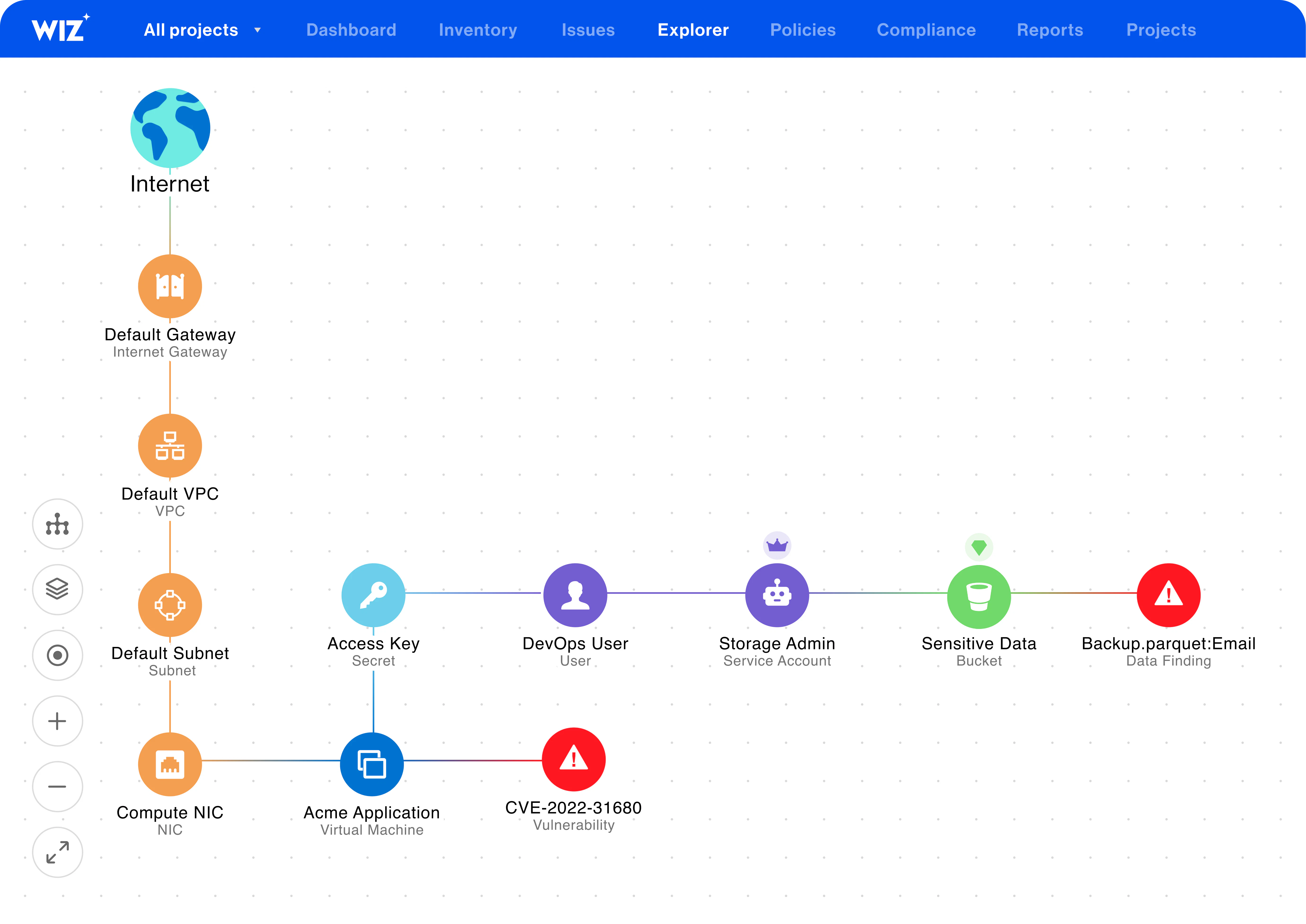
Visualization of a publicly exposed virtual machine with a critical vulnerability and lateral movement path to a bucket containing critical data.

Vulnerability management focuses on finding and patching known weaknesses, typically by scanning systems and matching results against CVE databases. Exposure management takes that data and asks a harder question: which of these weaknesses can an attacker actually reach and exploit right now?

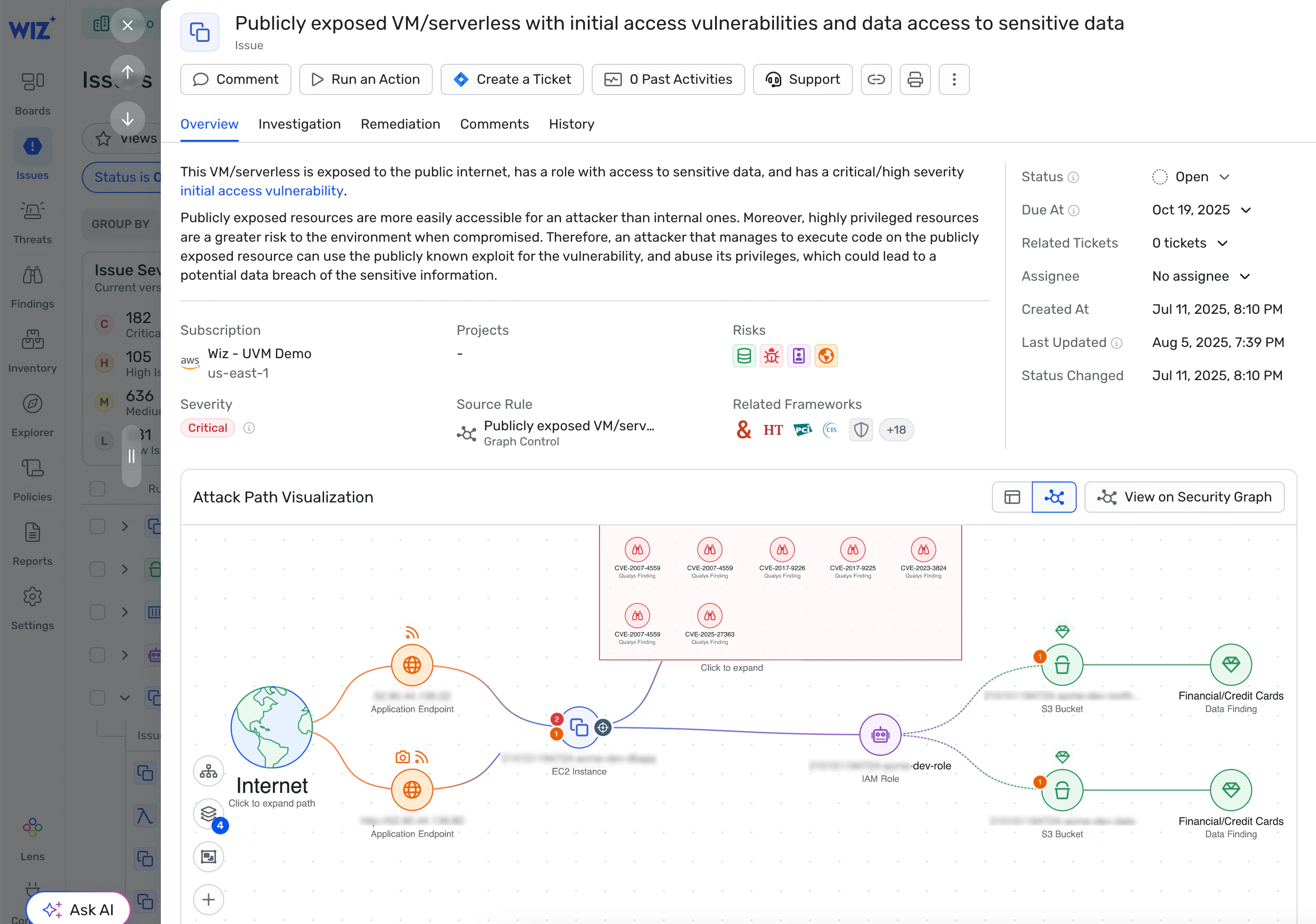
Consider a critical vulnerability on an internal server that has no network path to the internet and no sensitive data. Traditional vulnerability management flags it as high priority based on CVSS score alone. Exposure management recognizes that the same vulnerability on an internet-facing workload with access to production databases is the one that needs immediate attention.

AspectVulnerability managementExposure management
Primary focusFinding and patching known CVEsIdentifying what attackers can actually reach
Prioritization methodCVSS scores and severity ratingsRuntime context, network paths, and data access
ScopeSoftware vulnerabilitiesVulnerabilities plus misconfigurations, identity risk, and data exposure
OutcomePatch complianceReduced attack surface and exploitable risk

Importance of exposure management

Organizations that adopt exposure management see measurable improvements across several dimensions of their security program.

Risk reduction

Exposure management enables early detection and remediation of risks, helping you thwart potential threats before they are exploited by malicious actors. It limits your attack surface and enhances the security posture of your cloud environment.

Facilitated regulatory compliance

By continuously monitoring for vulnerabilities and ensuring that all security protocols and measures are up-to-date, exposure management ensures compliance with industry regulations such as GDPR, HIPAA, and PCI-DSS.

Operational continuity

When an organization swiftly manages exposures within their cloud environment, they prevent exploitations that cause downtime, data loss, or operational inefficiencies. This ensures smooth business operations and continuity.

Cost savings

One of the foremost impacts of a cyberattack is financial: remediation costs, legal fees, regulatory fines, and reputational damage—collectively costing organizations an average of $5 million per successful incident. By investing in exposure management, you can mitigate these risks and avoid the hefty costs associated with security incidents.

Improved security posture

The ongoing vigilance of exposure management ensures that organizations adapt to new threats and maintain updated defenses. Regular vulnerability scans, employee training, and implementing advanced security tools for discovery are integral parts of exposure management; they all also contribute to a resilient cybersecurity framework.

The process of exposure management

Managing exposure risk within an organization requires a detailed approach. Below is a breakdown of this process.

Identification

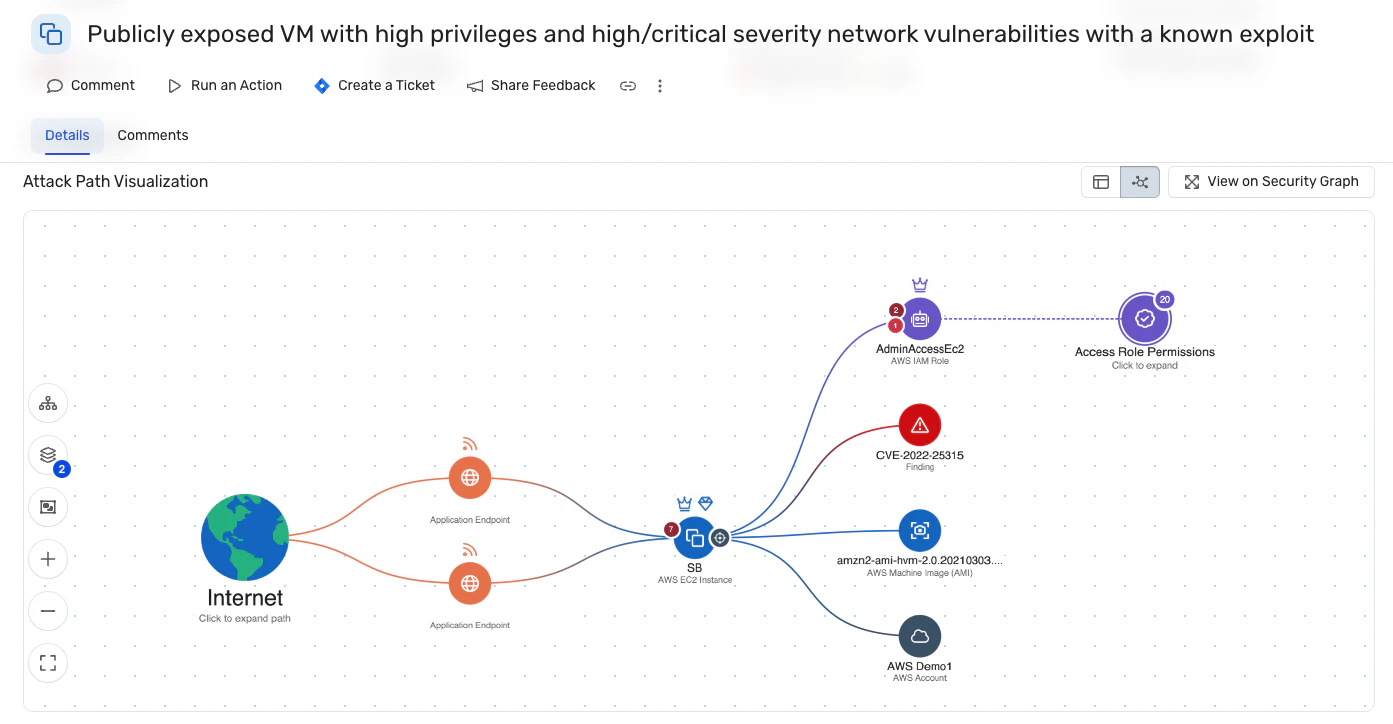
Visualization of a publicly exposed virtual machine that has a network vulnerability with a known exploit and high permissions.

You cannot protect what you cannot see. Before assessing risk, security teams need a complete inventory of assets across cloud infrastructure, on-premises systems, SaaS applications, and shadow IT. This includes resources that traditional asset management often misses.

For comprehensive discovery:

  • Use automated scanning tools to detect cloud workloads, containers, serverless functions, APIs, and databases across your environment.

  • Conduct regular security audits to review configurations, access controls, and security policies.

  • Inventory all IT assets and categorize them based on business criticality and data sensitivity.

  • Check domain and customIP ranges to identify SaaS applications and third-party services using company credentials.

Assessment

Discovery alone creates noise. Assessment transforms a list of potential issues into a prioritized queue by evaluating which exposures represent genuine risk to your organization.

Effective assessment considers:

  • Likelihood of exploitation: Is there a known exploit? Is the vulnerability being actively targeted in the wild?

  • Business impact: What data or systems would be affected if this exposure were exploited?

  • Attack path context: Is the exposed asset internet-facing? Does it have elevated privileges? Does it connect to sensitive data?

Mitigation

Risk mitigation strategies include the following:

  • Apply patches and updates to your software and systems to close security gaps.

  • Configure security controls. Examples include web application firewalls (WAFs), access controls, and intrusion detection and prevention systems (IDPS).

  • Divide up your infrastructure using network segmentation to curtail the spread of an attack, limiting the blast radius.

  • Develop and execute remediation plans tailored to specific vulnerabilities and their unique risks.

Monitoring

Cloud environments change constantly. New workloads spin up, configurations drift, and newly disclosed vulnerabilities shift your exposure posture overnight. Point-in-time assessments become stale within hours.

Continuous monitoring addresses this by:

  • Using agentless security solutions that scan your environment without requiring deployment on every workload.

  • Employing real-time detection to identify and alert on new exposures as they emerge.

  • Conducting periodic reassessments to catch configuration drift and newly vulnerable components.

  • Evaluating existing controls to verify they remain effective against current threats.

Intelligence

Threat intelligence provides information that you can use to anticipateand defend againstany and all threats. The following steps are instructive:

7 best practices for effective exposure management

The following practices help organizations operationalize exposure management beyond initial deployment:

1. Continuously monitor your internal exposure 

Conduct regular network and application scans to identify vulnerabilities. Ensuring your network has the latest software will close gaps in your security before hackers exploit them.

2. Implement strategies like the principle of least privilege (PoLP) and separation of duties

  • Leverage separation of duties to protect your environment.

  • Enforce the use of multi-factor authentication (MFA) for yet another layer of security. This tightens your network because on top of a password, users must also provide proper biometrics or other personal information to gain access.Another best practice is role-based access control (RBAC), which involves granting users permissions based on specific roles.

  • Lastly, the principle of least privilege (PoLP) ensures that employees can only access the bare minimum information required to perform their tasks, helping to restrict the access privileges of users to the absolute minimum necessary.

    Any functions that are not needed within an access area should be disabled to limit the extent of damage if an account is compromised.

3. Automate alerts

Automated alerts will immediately notify you of any exposures or unusual activities within your IT ecosystem. This facilitates prompt responses to threats before they escalate.

Ensure that the predefined security team receives notifications to act swiftly to resolve any identified exposure.

4. Conduct routine security audits 

Perform regular security audits to verify the effectiveness of implemented security controls and identify any new exposures. Third-party specialists (e.g., a red team or pen testers) may be a good idea to thoroughly assess your security posture and advise how to boost it. 

Maintain detailed records of security audits and use them to track progress, identify trends, and enhance security.

5. Develop a strong incident response plan

You'll need tried-and-true protocols to follow in the event of a cyberattack. Your incident response plan should provide these, as well as outline what tasks each member of your incident response team is responsible for. This ensures a coordinated handling of an attack should one occur.

Also, don't forget to conduct regular incident response drills to test the plan and familiarize all team members with their roles and necessary procedures.

6. Utilize advanced tools

Invest in advanced cybersecurity solutions that offer comprehensive exposure management, including vulnerability management, asset scanning, threat detection, and incident response capabilities.

The tool should leverage machine learning (ML) and artificial intelligence (AI), plus offer real-time monitoring and analysis across your organization for fast incident detection and remediation.

7. Conduct training for employees

Regularly train employees on cybersecurity best practices, empowering them to recognize suspicious activities and teaching proper password management. This includes awareness programs that educate them on phishing activities and social engineering. Conduct simulated exercises such as phishing tests to help them practice and reinforce their knowledge in a controlled environment.

A culture of continuous learning and awareness keeps employees informed about the latest threats and security best practices.

How Wiz approaches exposure management

Exposure management is more than finding vulnerabilities. It requires understanding how risks combine across cloud, code, and infrastructure to create real, exploitable exposure. That means visibility, context, and the ability to act on what matters most.

Wiz for Exposure Management delivers this through flexible deployment options. Use Wiz's native cloud, code, ASM, and sensor workload scanners, or leverage Wiz UVM to connect to your existing vulnerability tools, pen tests, SAST, DAST, and more—centralizing findings across cloud, code, and on-prem into one unified platform. The Wiz Security Graph enriches these findings with real-time context, surfacing the toxic combinations that represent actual business risk.

Whether the exposure originates in cloud configurations, container workloads, or application code, Wiz connects the dots so security teams can focus remediation on what attackers would actually target. The platform also supports end-to-end remediation with automated assignments, workflow integrations, and AI-generated fix guidance directly in code and IDEs.

Ready to see how unified exposure management works in practice? Get a demo to explore how Wiz helps security and engineering teams work from the same prioritized risk view.

Surface the exposures that matter most

Detect critical exposures that span across your cloud, code, SaaS, APIs and more.

For information about how Wiz handles your personal data, please see our Privacy Policy.