Wiz Research has been closely monitoring the evolving role of Agentic Offensive Frameworks in the threat landscape. We first covered this trend in our disclosure of attempts by Storm-0940, a Chinese-state aligned actor, to use ARTEX to conduct supply chain compromises into other software sectors. The next week, we shared the recurring fingerprints of agentic activity based on public and private cases. Then we closed out last month by sounding the alarm on Black October for AI Developer Platforms - linking nine disclosed incidents in an agentic attack trend.
We’ve also worked with our internal partners at Google Threat Intelligence Group in their coverage of Agentic Offensive Frameworks and the Significant Threshold that Agentic Threat Activity has crossed.
There has been explosive growth in successful agentic attacks, just in the last three weeks. Since publishing the Black October post, an additional twenty related incidents have been disclosed by vendors. Wiz’s CIRT has seen a 3x increase in engagement requests, matching the trend across the industry of overwhelming IR demand.
Wiz customers should review the Threat Center Advisory on this topic: AI Agent Frameworks Driving Cloud Intrusions: ARTEX and Related Tooling Indicators. Wiz Defend includes detections for these patterns and attackers, some of which are outlined both this post and the advisory.
Agentic Offensive Frameworks
The activity we’ve observed since late September 2026 uses ARTEX, its public forks and rebrands, and other agentic tools with a similar design.
ARTEX is only one of these frameworks: others seen in the wild include Cairn, CyberStrikeAI and HexStrike, alongside offensive use of generic harness like Hermes, as well as custom offensive harnesses. ARTEX is open source and has hundreds of forks. Activity attributed to “ARTEX” comes from multiple unrelated operators and should not be read as a single campaign or attributed to one threat actor.

Cases
Wiz Research and CIRT have been hunting, tracking, observing, and responding to a broad set of agentic offensive frameworks attacks, some successful. In addition to the examples we’ve previously shared, we wanted to provide some cases emblematic of what we’re seeing in this new threat environment.
Opportunistic Campaigns Using Agentic Offensive Frameworks
The first pattern we see is broad, seemingly opportunistic attacks by actors who have gone all-in on agentic offensive frameworks. These campaigns are frequently:
Proxied through residential and ISP pools: Requests rotate through commercial residential proxy inventory, often a new exit for every single request. IP-based blocking and IOC sharing do very little.
Noisy: These agents spray passwords, create canary accounts, hammer sign-up and password-reset flows, and probe every available endpoint. They also label their own work:
pentest,probe,recon, and incrementing task numbers show up in user agents, resource names and usernames.Vector agnostic: The same operator will try stolen cloud keys, identity-provider OAuth flows, public sign-up flows, anonymous storage access and CI/CD trust, in parallel and across many organizations.
Once a foothold is found, it is used to explore lateral movement, harvest credentials and exfiltrate data.
We wanted to highlight a campaign, one of a dozen campaigns we’re tracking, which we have named "ARTEX-Harvester." We’ve clustered this campaign based on, among other signals, a distinctive boto3 build, incrementing Intent ID correlation cross-victim, and proxy pool usage overlap.
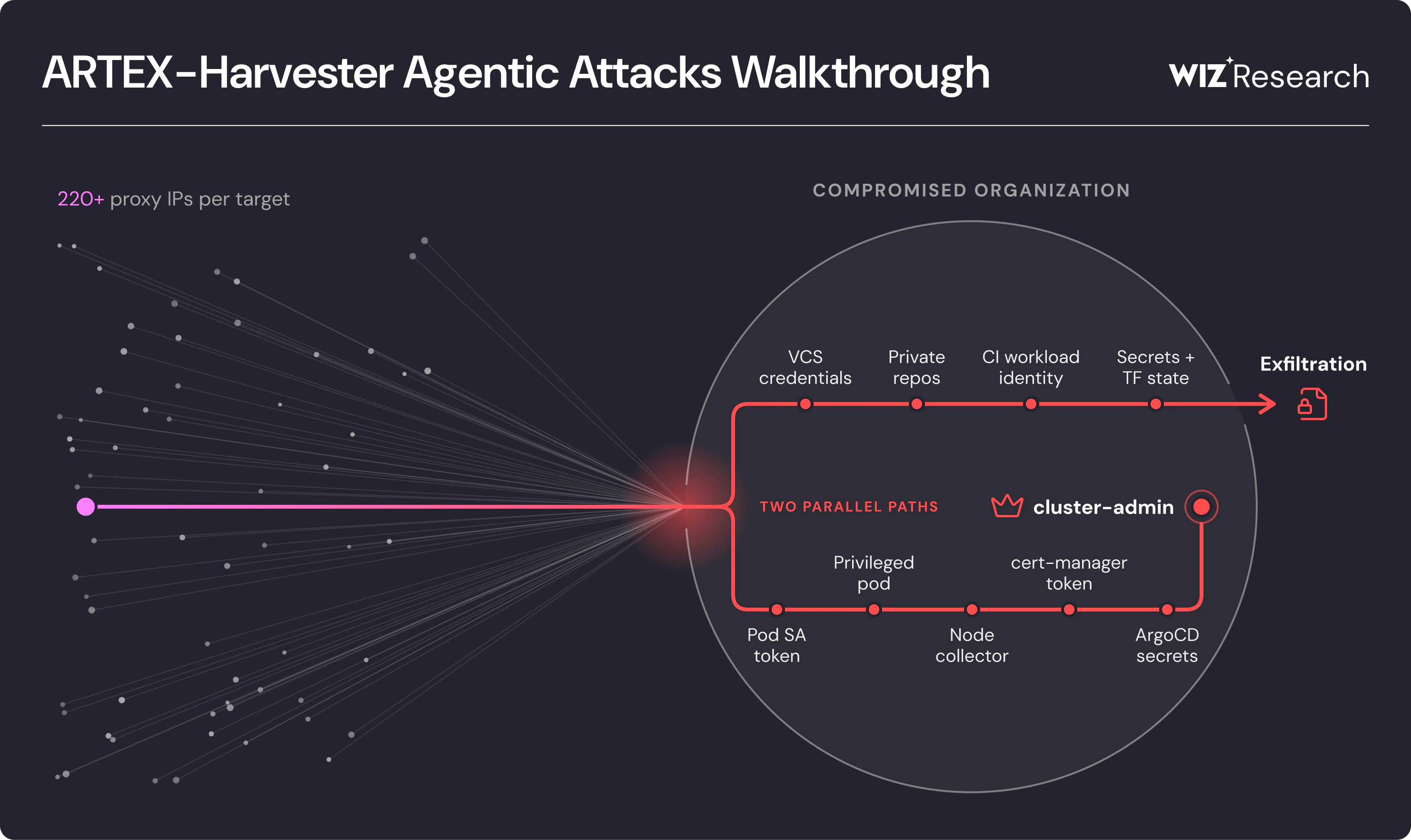
Between late October and mid-November 2026 we tied it, at varying confidence, to activity at more than a dozen organizations. It demonstrates exactly the patterns we highlighted. Almost every request used a different residential or ISP proxy exit - across more than 220 IPs in a single target.
Across the campaign, the same operator attempted:
Abuse of stolen credentials
Anonymous storage probing
Abuse of public sign-up, password-reset and sign-in flows
Identity-provider probing
Among the numerous attempted footholds, one success shows how these attacks progress once initial access is achieved.
Compromised VCS credentials allowed access to private repositories
The attack pivoted from CI to the cloud environment by creating branches that abused CI workload identity trust relationships.
Harvest workflows dumped CI-accessible secrets and Terraform state
Those secrets and repositories were exfiltrated
In parallel, the operator used a stolen service-account token from an application pod. That account could create privileged pods with the node's root filesystem mounted. The operator used that to deploy a "node-level collector" pod, which harvested the kubelet PKI and every projected service-account token on the node. One of those tokens, belonging to cert-manager, could read the ArgoCD secrets, leading to cluster-admin.
Detection
These attacks are far from stealthy. Wiz Issues captured this activity across a variety of rules that are agnostic to the usage of an Agentic Offensive Framework (see below).
Additionally, artifacts were heavily marked with agentic offensive framework self-labeling behavior, including pentest-recon user agents, pentest-* workspaces and pods, and an incrementing task intent counter (pentest-iNNNNNN).
Wiz Sensor caught the behavior within the cluster, including privileged container creation, nsenter, IMDS kube-env queries and drifted scripts reaching for cloud credentials.
Targeted Attacks and Open Directories
One of the more interesting byproducts of agentic offensive frameworks is a trend of poor operational security. ARTEX shipped with its web console exposed to the internet by default, often still on default credentials, and many operators never lock it down: Censys counted more than 1,400 exposed ARTEX consoles in early November.
The result is a steady supply of exposed command-and-control panels and open directories for threat intelligence and security firms to analyze.
Because these frameworks are agentic, those exposures reveal more than attacker actions. They capture the attack as a narrative: operator prompts, planner intents, agent transcripts and the model's own reasoning.
Seeing Both Sides of an Attack
This exposure occasionally grants something rare: both sides of the same intrusion. In some cases, we can pair our telemetry with the relevant attacker’s leaked logs and tools - granting a picture of not just what they did in a single incident, but what they did everywhere else, why they did it, and what they planned next.
Here is one such anonymized case:
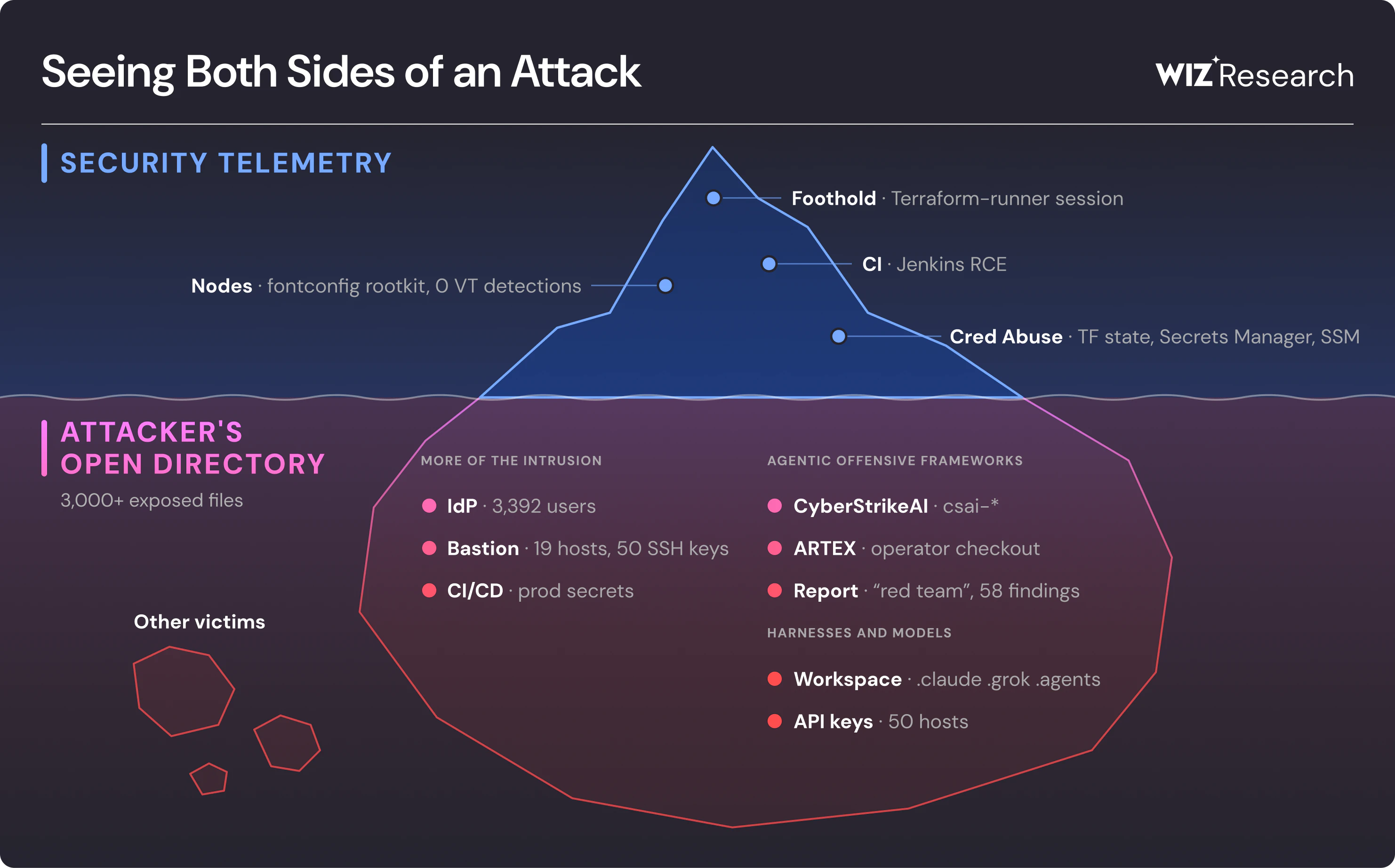
Across four days in October, an attacker navigated two AWS accounts and seven EKS clusters:
Initial foothold: a stolen Terraform-runner session read the kubelet kubeconfig, then created a privileged pod and a cluster-admin binding.
CI compromise: remote code execution on the Jenkins controller opened a reverse shell to the attacker's server.
Node persistence: a pod escape put a custom loader on the nodes. It was an
ld.so.preloaduserland rootkit with a DNS-tunnel channel, disguised as a fontconfig service, and had zero detections on VirusTotal.Credential use off-platform: node, IRSA and Terraform-runner credentials were used from the attacker's own server to read Terraform state and Secrets Manager, and to open SSM sessions.
The attacker’s open directory colors in the details, across over 3,000 exposed files.
It shows activity outside the observed telemetry:
Identity provider: forged admin tokens gave access to 3,392 users and their live session tokens.
Bastion: beacons were pushed to 19 hosts, and the bastion's database was decrypted for 50 SSH private keys.
CI/CD: GitHub Actions secrets were dumped, and the production Jenkinsfile was modified to run before its approval gate, exposing production secrets.
It also shows more about the attacker’s operations:
Command layer: CyberStrikeAI ran the operation. A csai- prefix is on nearly everything the attacker created (csai-escape pods, a csai-pentest-role IAM role, a csai-probe runner).
Operator workspace: an ARTEX checkout sat alongside .claude, .grok and .agents directories. The same server ran ARTEX tooling against several other organizations that month, unsuccessfully.
Reporting: the operator's own auto-generated Chinese language report masks the intrusion as an "authorised red-team pentest" and claims 58 findings.
AI tools as targets: Anthropic API keys were harvested from 50 hosts, and employees' AI coding-assistant session histories were mined for production SSO credentials.
Black October Q4
Finally, let’s revisit “Black October for AI Developer Platforms.”
Since publishing the blog post, disclosed incidents have more than tripled. While insufficient details have been shared to link all these incidents to any single actor, or even agentic offensive frameworks in some cases, there is a clear trend where attackers are using agentic offensive frameworks to target rich sources of LLM access and credentials.
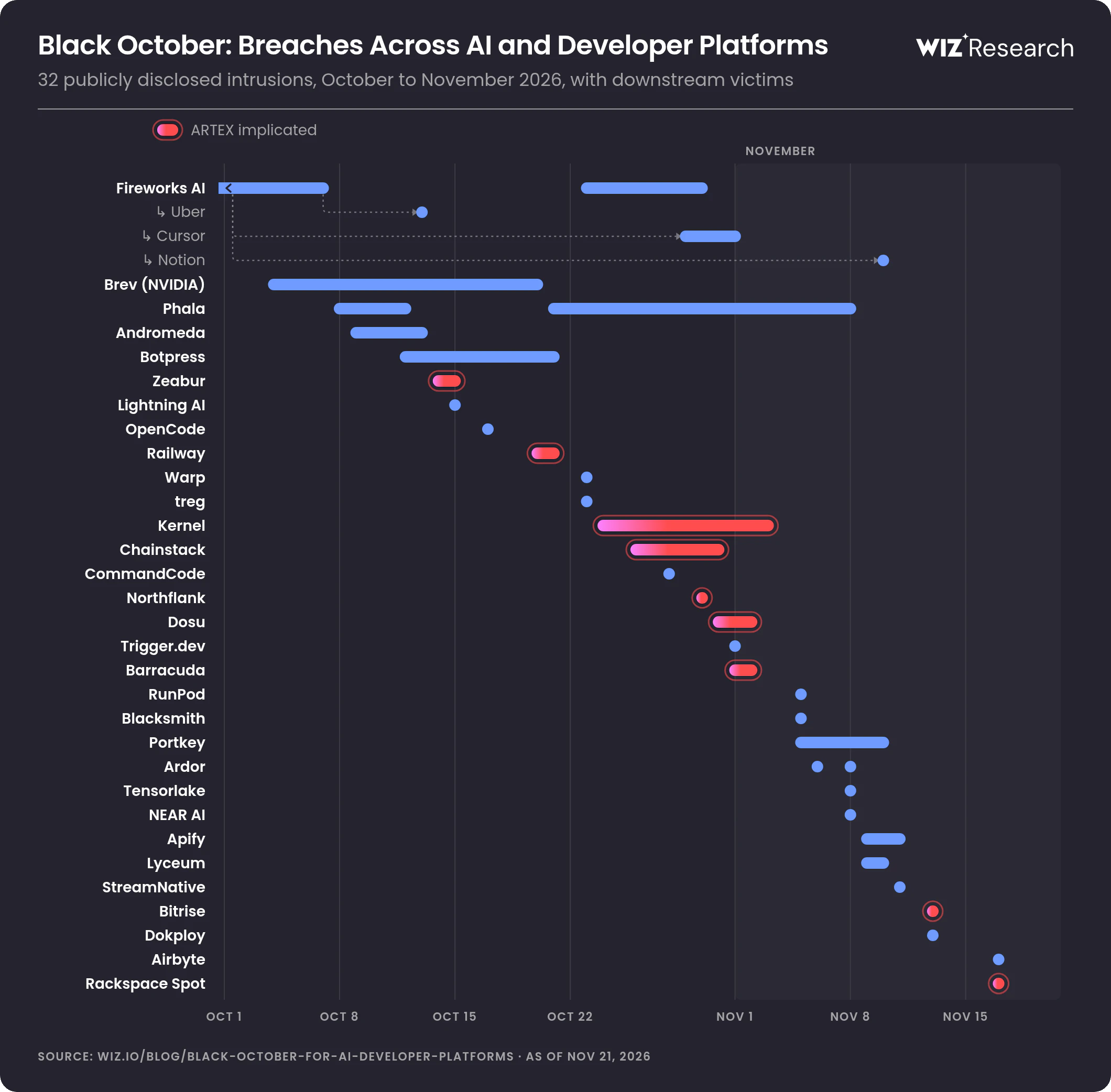
Where victims have disclosed a root cause, the entry points are familiar.
Stolen or leaked credentials (Zeabur, Kernel, Lightning AI, Bitrise)
Exposed or vulnerable services (Chainstack's default-credential Grafana, NEAR AI's SGLang RCE, Northflank's API zero-day)
Tenant-isolation escapes (Railway, Phala, Dokploy).
Increasingly, the way in was an upstream breach: keys and secrets stolen from one platform opened the next.
The impact is just as consistent. Attackers go straight for environment variables and stored customer secrets, prioritizing AI provider and cloud keys that can be validated, resold or burned on LLM usage within hours.
Recommendations
Wiz’s AI Threat Readiness Framework is our blueprint for how to build a security program that can stay ahead of these attacks. Defenders must put AI to work in order to leverage their context advantage against attackers and enable real machine-speed defense against these new tools and tactics.
Detections
The following is a representative subset of generic rules that have been observed in relation to agentic offensive framework attacks:
EC2 Instance Credentials Used Outside Of AWS
ECS Task Credentials Used Outside Of AWS
Unusual GetCallerIdentity Operation
Unusual Mass Access Denied Activity
Unusual Enumeration Activity by IAM User
API Calls From Unusual Country
API Calls by a Known Offensive Tool
Cluster Accessed From an Unusual Country
Unusual Mass Secret Value Retrieval
Attempts To Create Access Token For Multiple Service Accounts
IAM Role Assumed From New or Inactive Account
Model access check behavior tied to previously seen attacks
Azure Application Secret Used After Long Period of Inactivity
GCP Service Account Key Used After A Long Period Of Inactivity
IAM Access Key Used After Long Period of Inactivity
Instance Created Access Token Used Outside GCP
Permission To Impersonate Any Service Account Granted To Member
Wiz has also developed a set of behavioral detections specific to this activity. Among others, these include:
Session or Resource Name Matching an AI Offensive Tool Naming Pattern
AI Offensive Tool Step Counter in Session or Resource Names
Unusual Pagination Pattern by AWS Identity From New ASO
Activity From AI Offensive Tool IP Address Seen In Organization
AI Offensive Tool Activity Detected Via HTTP Endpoint
We note that these rules are expected to be perishable, given the inherent pace of evolution and customization of these tools. Wiz Research continues to develop advanced detection of these attacks based on the behavioral patterns of agent-driven intrusions (their speed, breadth and systematic structure), which persist even as individual tools are renamed, rebranded or customized.
IOCs
Wiz has compiled over 200 publicly reported Black October IOCs in our wiz-research-iocs repository.
The following are an assortment of IP addresses Wiz observed conducting attacks using agentic offensive frameworks. You can consume as a CSV from our wiz-research-iocs repository.
| IP Address | Hosting Provider | Category | Observed (2026) |
|---|---|---|---|
| 192.236.187[.]90 | HostPapa | Used with stolen credentials | Nov 5 – 18 |
| 104.223.50[.]72 | HostPapa | Used with stolen credentials | Nov 5 – 18 |
| 107.172.5[.]167 | HostPapa | Used with stolen credentials | Nov 5 – 18 |
| 107.173.104[.]66 | HostPapa | Used with stolen credentials | Nov 5 – 18 |
| 130.94.102[.]111 | LIGHT NODE | Used with stolen credentials | Nov 8 – 18 |
| 130.94.103[.]64 | LIGHT NODE | Used with stolen credentials | Nov 8 – 18 |
| 130.94.109[.]218 | LIGHT NODE | Used with stolen credentials | Nov 8 – 18 |
| 38.60.171[.]222 | LIGHT NODE | Used with stolen credentials | Nov 8 – 18 |
| 172.86.80[.]80 | RouterHosting | Used with stolen credentials | Late Oct – Nov 22 |
| 172.86.82[.]159 | RouterHosting | Used with stolen credentials | Late Oct – Nov 22 |
| 172.86.82[.]160 | RouterHosting | Used with stolen credentials | Late Oct – Nov 22 |
| 172.86.82[.]161 | RouterHosting | Used with stolen credentials | Late Oct – Nov 22 |
| 172.86.82[.]163 | RouterHosting | Used with stolen credentials | Late Oct – Nov 22 |
| 172.86.82[.]164 | RouterHosting | Used with stolen credentials | Late Oct – Nov 22 |
| 172.86.82[.]178 | RouterHosting | Used with stolen credentials | Late Oct – Nov 22 |
| 172.86.82[.]179 | RouterHosting | Used with stolen credentials | Late Oct – Nov 22 |
| 118.107.19[.]99 | CTG Server | Used with stolen credentials | Nov 3 – 23 |
| 137.220.202[.]200 | CTG Server | Used with stolen credentials | Nov 3 – 23 |
| 134.122.173[.]40 | CTG Server | Used with stolen credentials | Nov 3 – 23 |
| 134.122.163[.]240 | CTG Server | Used with stolen credentials | Nov 3 – 23 |
| 143.92.37[.]131 | CTG Server | Used with stolen credentials | Nov 3 – 23 |
| 68.166.169[.]20 | FDCservers | Used with stolen credentials | Nov 12 – 23 |
| 134.222.209[.]136 | EGIHosting | Used with stolen credentials | Nov 12 – 23 |
| 129.80.215[.]35 | Oracle Cloud | Used with stolen credentials | Nov 12 – 23 |
| 129.121.162[.]36 | Oracle Cloud | Used with stolen credentials | Nov 12 – 23 |
| 43.172.40[.]251 | Tencent Cloud | Used with stolen credentials | Nov 19 – 22 |
| 129.226.56[.]74 | Tencent Cloud | Used with stolen credentials | Nov 19 – 22 |
| 142.86.89[.]21 | Tencent Cloud | Used with stolen credentials | Nov 19 – 22 |
| 168.143.104[.]44 | NTT | Used with stolen credentials | Nov 15 – 23 |
| 103.27.80[.]145 | NTT | Used with stolen credentials | Nov 15 – 23 |
| 216.203.20[.]186 | BL Networks | Used with stolen credentials | Nov 14 – 19 |
| 66.179.31[.]32 | BL Networks | Used with stolen credentials | Nov 14 – 19 |
| 8.208.101[.]210 | Alibaba Cloud | Used with stolen credentials | Sep 30 – Nov 22 |
| 8.222.148[.]117 | Alibaba Cloud | Used with stolen credentials | Sep 30 – Nov 22 |
| 47.79.40[.]236 | Alibaba Cloud | Used with stolen credentials | Sep 30 – Nov 22 |
| 47.84.82[.]39 | Alibaba Cloud | Used with stolen credentials | Sep 30 – Nov 22 |
| 47.79.89[.]122 | Alibaba Cloud | Used with stolen credentials | Sep 30 – Nov 22 |
| 58.243.42[.]153 | China Unicom | Used with stolen credentials | Oct 31 – Nov 6 |
| 123.116.51[.]114 | China Unicom | Used with stolen credentials | Oct 31 – Nov 6 |
| 5.181.181[.]168 | Mynymbox | Used with stolen credentials | Late Oct – Nov 23 |
| 37.77.150[.]119 | Proton66 | Used with stolen credentials | Late Oct – Nov 23 |
| 45.76.225[.]196 | Vultr | Used with stolen credentials | Late Oct – Nov 23 |
| 72.57.131[.]24 | — | Used with stolen credentials | Late Oct – Nov 23 |
| 149.255.35[.]138 | Hivelocity | Used with stolen credentials | Late Oct – Nov 23 |
| 154.86.0[.]28 | LightLayer | Used with stolen credentials | Late Oct – Nov 23 |
| 157.22.126[.]128 | Global Transit Systems | Used with stolen credentials | Late Oct – Nov 23 |
| 162.251.248[.]190 | — | Used with stolen credentials | Late Oct – Nov 23 |
| 166.0.23[.]89 | Evoxt | Used with stolen credentials | Late Oct – Nov 23 |
| 180.178.51[.]150 | N963 | Used with stolen credentials | Late Oct – Nov 23 |
| 187.77.250[.]192 | Hostinger | Used with stolen credentials | Late Oct – Nov 23 |
| 194.59.30[.]231 | — | Used with stolen credentials | Late Oct – Nov 23 |
| 199.19.77[.]84 | 3K33 | Used with stolen credentials | Late Oct – Nov 23 |
| 45.199.130[.]250 | Zillion Network | Used with stolen credentials | Late Oct – Nov 23 |
| 111.223.247[.]165 | BGP Network | Used with stolen credentials | Late Oct – Nov 23 |
| 45.38.20[.]153 | Aokigahara | Used with stolen credentials | Late Oct – Nov 23 |
| 85.193.69[.]250 | B2 Net Solutions | Used with stolen credentials | Late Oct – Nov 23 |
| 82.29.53[.]185 | Hosteons | Used with stolen credentials | Late Oct – Nov 23 |
| 68.68.250[.]114 | — | ARTEX operator host | Late Oct – Nov 1 |
| 192.238.246[.]157 | — | ARTEX operator host | Late Oct – Nov 1 |
| 104.207.150[.]173 | Vultr | ARTEX operator host | Late Oct – Nov 1 |
| 2.26.225[.]135 | VPSPay Networks | Stolen credentials + wide probing/spraying (match may be a failed attempt) | Oct 31 – Nov 23 |
| 109.238.87[.]4 | B2 Net Solutions | Stolen credentials + wide probing/spraying (match may be a failed attempt) | Oct 31 – Nov 23 |
| 111.223.247[.]202 | BGP Network | Stolen credentials + wide probing/spraying (match may be a failed attempt) | Oct 31 – Nov 23 |
| 130.94.108[.]151 | LIGHT NODE | Stolen credentials + wide probing/spraying (match may be a failed attempt) | Oct 31 – Nov 23 |
| 161.77.116[.]139 | RingSquared | Stolen credentials + wide probing/spraying (match may be a failed attempt) | Oct 31 – Nov 23 |
| 185.87.121[.]140 | MDN Technology | Stolen credentials + wide probing/spraying (match may be a failed attempt) | Oct 31 – Nov 23 |
| 45.199.130[.]245 | Zillion Network | Stolen credentials + wide probing/spraying (match may be a failed attempt) | Oct 31 – Nov 23 |
| 2.26.226[.]17 | VPSPay Networks | Stolen credentials + wide probing/spraying (match may be a failed attempt) | Oct 31 – Nov 23 |
| 2.26.225[.]235 | VPSPay Networks | Stolen credentials + wide probing/spraying (match may be a failed attempt) | Oct 31 – Nov 23 |
| 134.122.173[.]60 | CTG Server | Stolen credentials + wide probing/spraying (match may be a failed attempt) | Oct 31 – Nov 23 |
| 130.94.103[.]197 | LIGHT NODE | Stolen credentials + wide probing/spraying (match may be a failed attempt) | Oct 31 – Nov 23 |
| 76.13.169[.]197 | Hostinger | Stolen credentials + wide probing/spraying (match may be a failed attempt) | Oct 31 – Nov 23 |
| 82.29.131[.]60 | Hosteons | Stolen credentials + wide probing/spraying (match may be a failed attempt) | Oct 31 – Nov 23 |
| 130.94.35[.]151 | LIGHT NODE | Stolen credentials + wide probing/spraying (match may be a failed attempt) | Oct 31 – Nov 23 |