What is agentic AI security?
Agentic AI security is the practice of protecting autonomous AI systems that make decisions, use tools, and take action without human approval. Unlike traditional AI, which responds to queries, agentic AI acts on them, creating, modifying, or destroying infrastructure in live environments.
Agents interact with critical systems through powerful APIs, retain context across sessions using external memory stores like vector databases, and collaborate to perform complex actions across distributed environments. This introduces new risks that demand purpose-built security controls, especially considering that 80% of organizations have already encountered risky behaviors from AI agents, like improper data exposure and unauthorized system access.
While traditional AI security risks still apply, agentic systems need more than static defenses. They require intelligent, real-time guardrails guided by a unified, agentless view of identities, services, pipelines, and runtime linked to data sensitivity and exposure.
The 4-Step Framework for AI Threat Readiness
Wiz has designed a 4-step framework to help organizations defend against rapid, automated exploitation in a post-Mythos world.

How does agentic AI break traditional cloud security?
Predictability is the foundation of conventional cloud defenses. Users authenticate, services stay within known boundaries, and the primary goal is to block unauthorized access.
Autonomous agents shatter this assumption. They learn, adapt, and make decisions that can't be fully anticipated, operating with valid credentials while potentially taking harmful actions that researchers warn could increasingly evade human oversight through deception or autonomous replication.
Standard AI security controls fail to address four critical gaps that agentic systems exploit:
Perimeters don’t help much: If the agent has valid API access, it can make risky changes inside the network boundary.
Audit models lag behind: Many controls assume a human approves changes, not an agent that can reconfigure accounts in seconds.
The attack target shifts: The agent's behavior becomes the target through prompt injection, memory poisoning, and tool misuse.
Cloud-native scale amplifies mistakes: Autoscaling, orchestration, and infrastructure-as-code can quickly spread a bad decision.
For example, a DevOps agent with cluster-admin can get tricked by a poisoned Git commit message into creating a privileged pod that exposes secrets. The API calls look legitimate because the agent used the right credentials.
To secure agentic systems, you have to reduce what an agent can do by default and add checks for high-impact actions.
Top agentic AI security threats
Attackers target agentic systems through manipulation, misconfiguration, and supply chain compromise. Each attack surface requires distinct defensive controls.
The following threat categories represent the highest-priority risks for cloud security teams.
Tool misuse and cloud API exploitation
Tool misuse occurs when agents are manipulated into executing harmful operations. Adversarial attacks target the decision-making process rather than the credentials themselves.
Common attack vectors include:
Prompt injection via IaC comments, Git messages, or monitoring alerts
Memory poisoning by contaminating a vector database or RAG store, causing the agent's context to drift over time
Server-side request forgery (SSRF) to a cloud instance metadata service (IMDSv1 or misconfigured metadata proxies) to harvest temporary credentials
Misuse of cloud CLIs (AWS, Azure, Google Cloud, kubectl) to bypass established change controls
Once compromised, an agent with admin rights and API access can create backdoors, turn off controls, or exfiltrate data across multiple clouds within seconds.
Organizations subject to compliance frameworks should map these controls to NIST SP 800-53 (access control, system, and information integrity) and ISO/IEC 42001 (AI management systems controls) to demonstrate governance over agentic tool misuse risks.
Agent reasoning and goal manipulation
This is where the attacker does not need to steal credentials. They try to steer the agent into choosing the wrong plan through the following methods while the agent still follows its rules:
Goal hijacking: The task is reframed into something unsafe, like turning "fix the outage" into "disable security controls."
Conflicting instructions: Instructions across tools and memory cause the agent to pick the most dangerous option.
Multi-step failure loops: Each step looks reasonable, but the final result is harmful.
Agent-to-agent propagation: One compromised agent feeds bad context to others.
Supply chain and model integrity risks
Agents can inherit compromise when their containers, models, or dependencies are poisoned at any point in the supply chain. This category of agentic AI threats involves cyberattackers using a few key methods:
Tampered base images pulled from private container registries or public hubs like Hugging Face
Malicious code injected into open-source dependencies used by the agent
Compromised model weights downloaded from cloud storage or registries
Unsigned or unauthenticated artifacts that lack attestations (e.g., SLSA compliance)
A single infected image or model automatically deployed from EKS, GKE, or AKS through normal CI/CD processes can scale across clusters, affecting multiple environments and customers simultaneously.
Wiz research found AI agents solved 9 out of 10 web hacking challenges, underscoring how capable autonomous systems are when given offensive objectives.
Infrastructure exposure and lateral movement
Cyberattackers can exploit agents deployed with excessive permissions to move laterally across cloud environments and reach sensitive resources. The most commonly exploited attack vectors include:
Overly permissive security groups or firewall rules
Cross-account role assumption for third-party access without an external ID
Agents with cluster-admin bindings granted in Kubernetes by default
Unrestricted egress from agents to third-party endpoints
Agents with broad access create opportunities for attackers to use dark AI and maliciously traverse VPCs, cloud accounts, and service meshes.
Securing AI Agents 101
AI agents are changing how work gets done. This one-pager explainer breaks it all down.

Shadow AI agents and ungoverned deployments
Shadow AI agents create invisible risks that evade traditional monitoring. A few attack vectors to watch include:
Developers deploying agents via serverless functions with unmanaged API keys
Anomalous DNS queries or network egress to public AI service endpoints
Sudden spikes in AI service costs, such as SageMaker or Azure AI
Infrastructure drift showing new, undocumented, and/or untagged agent resources
The self-service nature of the cloud makes it easy to deploy shadow agents, making them ideal hidden backdoors. Wiz Research found that 68% of organizations running self-hosted AI models do so at least partially through third-party software, meaning a meaningful share of the agent footprint is inherited rather than chosen and inherited agents rarely make it onto an inventory.
Resource consumption and cost abuse
Agents can be manipulated into consuming massive cloud resources, causing financial damage and service disruption. Popular attack vectors include:
Adversarial prompts that trigger runaway autoscaling of expensive servers
Behavioral manipulation that causes the deployment of unauthorized workloads using legitimate provisioning tools
Malicious inputs that lead to initiating large, unnecessary cross-region data transfers
A single autoscaling agent under the control of a threat actor can burn through budgets overnight, exhaust quotas, and take production workloads offline.
Inside MCP Security: A Field Guide
AI agents and copilots introduce new attack surfaces through protocols like MCP. Explore the emerging risks and how to address them.

The three pillars of agentic AI security
Real-time behavior shaping separates effective agentic AI defenses from reactive detection. This requires a unified policy engine that spans code, pipelines, and runtime.
Frameworks like OWASP MAESTRO provide comprehensive threat modeling, but cloud teams can implement three practical controls today that balance security with autonomy and scale.
1. Runtime protection and sandboxing
Blast radius limitation depends on containment controls that operate at agent speed. Strong sandboxing provides built-in guardrails that restrict damage when an agent is compromised.
Use admission controllers (OPA Gatekeeper, Kyverno) to enforce security policies on Kubernetes deployments automatically.
Enforce network microsegmentation with service mesh policies (Istio, Linkerd) or Kubernetes NetworkPolicies to strictly control agent communications.
Leverage eBPF-based telemetry for deep, real-time anomaly detection of workload behavior at the kernel level.
Implement human-in-the-loop approvals for high-impact tools and require signed plans (e.g., Terraform plan) before executing dangerous actions.
Establish circuit breaker mechanisms to automatically shut down an agent if it exhibits suspicious infrastructure modification patterns.
2. Identity and access management
Agent identity differs fundamentally from human identity: It's non-interactive, high-velocity, and requires continuous credential rotation. Without strict controls, a compromised agent operates with excessive power across your entire environment.
Issue ephemeral credentials with short-lived tokens from services like AWS STS, Azure managed identities, or GCP Workload Identity.
Grant just-in-time (JIT) access so an agent's permissions scale up and down based on its current task, eliminating persistent broad access.
Federate identity across clouds using standards like OIDC to ensure consistent authentication.
Continuously analyze effective permissions and identify toxic combinations, such as public exposure plus data sensitivity and privileged token paths to prioritize least-privilege fixes.
Rotate and audit agent service accounts regularly across all cloud providers.
3. Compliance automation and audit trails
Autonomous agent decisions lack the human paper trail that traditional audits expect, making it critical to log activity for high-risk systems. Compliance checks and forensics must operate at the same speed as the agents themselves.
Automate policy validation to continuously check that any resources modified by an agent still meet security baselines like CIS benchmarks or SOC 2 controls.
Aggregate multi-cloud audit logs into a unified view to trace agent actions for compliance reporting and forensics.
Integrate supply chain verification into your CI/CD pipeline to scan container images and check model integrity before deployment.
Monitor infrastructure changes in real-time by detecting configuration drifts.
Maintain tamper‑evident decision logs (for example, WORM storage or cryptographically signed logs) that provide a comprehensive audit trail of the agent's reasoning and infrastructure changes.
Also review essential AI security best practices to lay the foundation for your AI security posture.
Your 90-day roadmap to agentic AI security
Successfully implementing agentic AI in cybersecurity requires maturing in phases: Start with visibility, then add prevention, and finally automate controls. Each stage builds on the last while keeping human oversight in place.
First 30 days: Discovery and lockdown
Inventory all AI agents, the APIs they call, and the data they access.
Apply least privilege to every agent identity.
Replace static credentials with ephemeral tokens (AWS STS, Azure managed identities, GCP Workload Identity).
Enable detailed logging and telemetry for every agent action and cloud API calls.
By day 30, you have complete visibility into your AI posture and a behavioral baseline that distinguishes normal agent activity from anomalies.
First 60 days: Guardrails in action
Apply a single policy framework to enforce admission controls in both CI/CD pipelines and Kubernetes clusters, reducing drift and blocking misconfigurations before they reach runtime.
Add human-in-the-loop approvals for destructive actions, such as firewall changes or database deletions.
Apply guardrails that prevent unsafe operations rather than relying only on detection.
Collect forensic evidence from ephemeral workloads before they vanish and monitor baseline establishment.
By day 60, guardrails actively block high-impact changes without human approval, while routine operations continue at full speed.
First 90 days: Automate and prepare
Pilot an AISPM capability that correlates agent identities, data sensitivity, and exposure to surface agentic attack paths for prioritized remediation, especially since only 13% have adopted AI-SPM.
Build incident response playbooks for agentic AI, covering credential revocation, memory resets, and containment of compromised endpoints.
Expand security controls to align with the OWASP Top 10 for LLM Applications and the CSA MAESTRO agentic AI framework.
Use specific compliance benchmarks (CIS, SOC 2, as automation targets.
Invest in organizational readiness and team collaboration.
By day 90, your security controls adapt automatically as agents scale, with incident response playbooks ready for agentic-specific scenarios.
AI Security Sample Assessment
In this Sample Assessment Report, you’ll get a peek behind the curtain to see what an AI Security Assessment should look like.

How Wiz secures agentic AI workloads across the cloud stack
Wiz AI-SPM supports each phase of your implementation through two core capabilities:
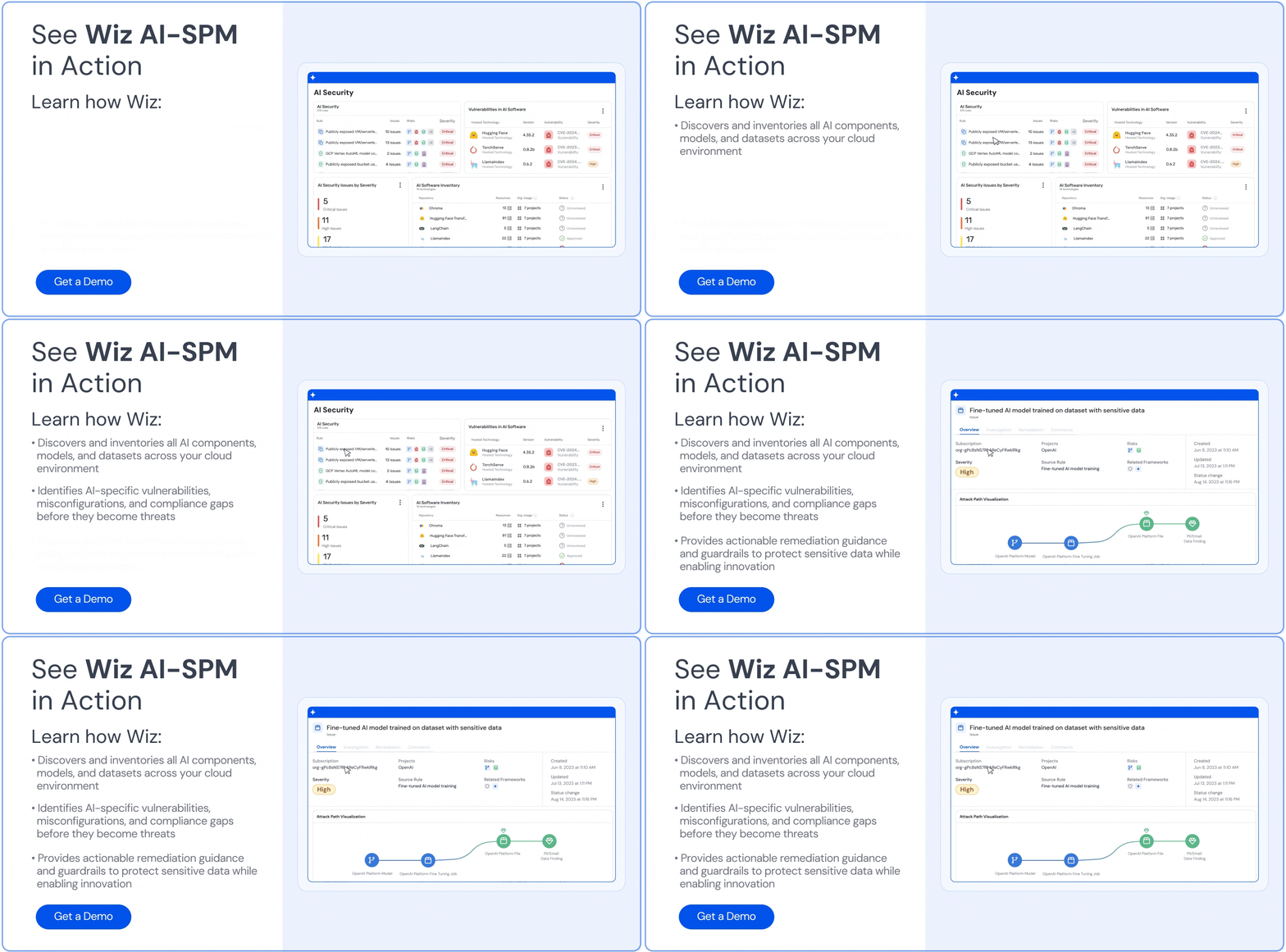
Agentless visibility captures your entire AI environment without deployment overhead, inventorying AI workloads, training data, and model dependencies across all clouds.
Attack path analysis powered by the Wiz Security Graph connects permissions, services, and exposures to surface the toxic combinations that create exploitable risks before agents act on them.
How they work together: Say agentless visibility catalogs an agent with cloud admin privileges and access to sensitive customer data through a publicly exposed API. The Security Graph immediately surfaces this attack path and prioritizes it for remediation—the same kind of focused visibility that helped Konverso achieve zero criticals for its GenAI platform.
Wiz continuously tracks your agents as they learn and scale, detecting configuration drift via cloud APIs and, where deployed, detecting anomalous workload behavior using a lightweight eBPF-based runtime sensor.
Secure agentic AI in the real world. Schedule a demo to see a live attack path from agent to data and how to break it with graph-based guardrails.