



What is AI threat detection?
AI threat detection uses machine learning, behavioral analytics, and automation to identify cyber threats in real time. By analyzing telemetry across networks, identities, and cloud environments, these systems move beyond traditional, signature-based tools to flag suspicious deviations from normal behavior.
This approach is essential for identifying modern risks:
Behavioral baselining: Detects zero-day activity and unknown attack patterns by identifying anomalies.
Scalable analysis: Processes massive alert volumes that manual investigation cannot handle.
Proactive defense: Surfaces potential risks before they escalate into security incidents.
AI Security Starter Pack
Build a practical foundation for securing AI workloads, models, data, and connected cloud services.

This capability is critical as attack cycles accelerate. According to the Wiz 2026 State of AI in the Cloud, AI adoption has reached a tipping point, with organizations increasingly leveraging these models to manage the sheer complexity of cloud-native architectures. However, this growth also means the "attack surface" for AI itself is expanding, making specialized detection non-negotiable.

How AI detects threats
AI-driven security tools compare historical activity with real-time telemetry to spot patterns linked to malicious behavior. By analyzing data across networks, endpoints, identities, cloud environments, and threat intelligence feeds, these systems can detect suspicious activity far faster than manual investigation alone.
AI also helps accelerate parts of the threat intelligence lifecycle by correlating signals across multiple sources, enriching alerts with context, and prioritizing the activity most likely to represent genuine compromise. Instead of treating every alert equally, AI helps security teams reduce noise, improve triage, and focus investigations on the highest-risk threats first.
The AI threat detection pipeline
Most AI threat detection systems follow a structured process that moves from data collection to analyst review.
Data ingestion: The system collects logs, network traffic, endpoint telemetry, identity events, and cloud activity from across the environment.
Preprocessing: Raw data is cleaned, normalized, and enriched so it can be analyzed consistently.
Pattern analysis: Machine learning models examine activity for suspicious behaviors, known indicators of compromise, and unusual relationships between events.
Baseline establishment: The system learns what normal behavior looks like for users, workloads, devices, and network traffic.
Anomaly detection: AI flags activity that deviates from those baselines and may indicate compromise.
Threat scoring: Findings are prioritized based on severity, exploitability, asset criticality, and surrounding context.
Alerting: High-priority threats are routed into security workflows through SIEM, SOAR, or case management integrations.
Human review: Security analysts validate findings, investigate context, and decide how to respond.
Human oversight remains critical throughout the process. AI can process massive volumes of telemetry and surface suspicious patterns quickly, but analysts provide the context and judgment needed to determine whether activity represents a real threat, a benign anomaly, or part of a larger attack path.
Key AI techniques for threat detection
AI threat detection relies on several machine learning techniques, each designed to identify different types of malicious activity and behavioral patterns.
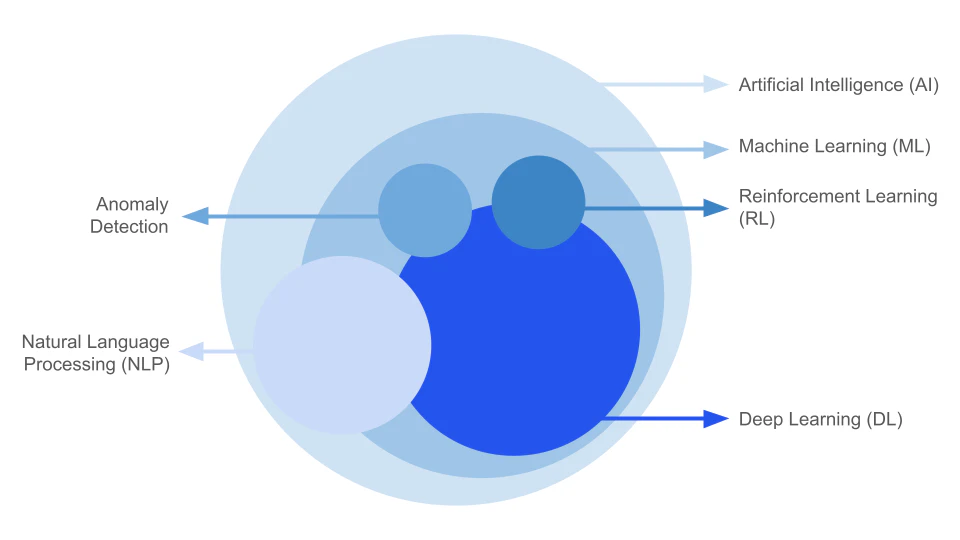
Deep learning (DL): Neural networks identify complex patterns in large datasets that simpler models might miss. In threat detection, DL can analyze network traffic, malware behavior, and file activity to identify subtle indicators of compromise.
Natural language processing (NLP): NLP analyzes emails, messages, and other text-based content to detect phishing attempts, malicious prompts, and social engineering activity based on suspicious language patterns and contextual anomalies.
Reinforcement learning (RL): Reinforcement learning improves decision-making through repeated trial and feedback. In security operations, it can help optimize investigation paths and automate parts of threat response workflows.
Anomaly detection: Anomaly detection identifies behavior that deviates from established baselines, such as unusual login activity, unexpected privilege escalation, or abnormal data transfers.
Supervised vs. unsupervised learning: Supervised machine learning models train on labeled datasets of known attacks to recognize similar threats in the future. Unsupervised models work differently by identifying patterns and anomalies without predefined labels, making them useful for detecting unknown or evolving attack techniques. Many AI detection systems combine both approaches.
These AI security techniques work together to improve detection accuracy, reduce manual investigation effort, and identify threats that traditional signature-based tools may miss.
Why is AI threat detection critical in modern cybersecurity?
Security teams are under increasing pressure to respond to threats across distributed environments. Attackers can now automate reconnaissance and lateral movement at a scale that manual investigation cannot match.
The Wiz 2026 Cloud Threat Retrospective highlights a significant shift in the threat landscape: cloud-targeted attacks are becoming more sophisticated, frequently exploiting misconfigured identities and over-privileged roles. AI threat detection helps address these challenges by improving speed, volume, and accuracy.

For modern security teams, AI threat detection is becoming essential for closing the gap between increasingly automated AI-driven threats and the operational reality of defending against them with limited time, personnel, and manual investigation capacity.
AI threat detection helps address these challenges by improving speed, scalability, visibility, and response efficiency across security operations:
Speed: AI reduces detection and response time by analyzing telemetry, pinpointing subtle indicators of compromise (IoCs), and prioritizing suspicious activity in real time.
Volume: AI can process large volumes of security data across networks, endpoints, cloud environments, and threat intelligence feeds at a scale that manual workflows cannot match.
Accuracy: AI correlates signals across multiple systems to reduce noise, improve alert fidelity, and surface high-risk activity faster. By learning from past incidents and behavioral patterns, AI can continuously refine detection models and reduce alert fatigue, as seen in Hivebrite’s reported 85% decrease in alerts.
Proactiveness: Unlike traditional signature-based tools, AI can identify abnormal behavior and potential zero-day activity before attacks fully escalate.
Scalability: AI-driven systems support automated triage, investigation, and response workflows through integrations with SIEM and SOAR platforms.
Rule-based vs. AI threat detection
Rule-based and AI-driven threat detection solve different security problems. The comparison below highlights how they differ across speed, adaptability, transparency, and operational scale.
| Factor | Rule-based threat detection | AI threat detection |
|---|---|---|
| Speed | Fast for known threats | Real-time analysis at scale |
| Accuracy | High for established patterns | Can be high, depends on training and tuning |
| Ability to detect unknown threats | Limited to known signatures | Strong at spotting anomalies and new patterns |
| Adaptability | Static, requires manual updates | Improves as it learns from new data |
| Transparency | Clear, rule-based logic | Can be opaque without explainability |
| Complexity | Simpler to deploy and manage | More complex models and pipelines |
| Resource requirements | Lower compute and tuning overhead | Higher training and data needs |
Most organizations benefit from combining both approaches. Rule-based detection provides reliable coverage for known threats, while AI improves scalability, anomaly detection, and visibility into unfamiliar attack patterns.
Use cases for AI threat detection
AI threat detection is most effective in high-volume environments where subtle attack patterns are difficult to identify manually.
| Use case | How AI helps | Real-world application |
|---|---|---|
| Intrusion detection (IDS) | Analyzes network traffic in real time for anomalies. | Could have flagged the 2017 Equifax breach traffic early. |
| Phishing detection | Inspects email metadata, content, and links for malicious patterns. | Gmail filters flag malicious emails before they hit user inboxes. |
| Anomaly detection | Monitors access logs and API calls for suspicious activity. | Detects unauthorized access to S3 buckets from unknown IPs. |
| Malware detection | Flags ransomware-like file modifications or encryption behavior. | Could have contained WannaCry by isolating infected devices early. |
| EDR/XDR | Correlates endpoint telemetry to spot fileless or lateral attacks. | Links PowerShell execution to suspicious network connections. |
Challenges and limitations of AI threat detection
While AI is a powerful force multiplier for cybersecurity, it is not a silver bullet. AI-driven detection systems still require tuning, oversight, and operational context to remain effective.
False positives & false negatives
AI models depend heavily on training quality, tuning, and environmental context. Overly sensitive models can overwhelm analysts with false positives, while weaker models may miss genuine threats, including novel or zero-day attacks.
Mitigate by: Combining AI with human oversight and rule-based detection to improve accuracy while reducing alert noise.
Black-box complexity
Some AI models lack explainability, making alerts harder to investigate and security decisions harder to justify to auditors, leadership, and other stakeholders.
Mitigate by: Prioritizing AI solutions with explainability features such as confidence scoring, correlation mapping, and investigation context.
AI-specific attacks
Threat actors are increasingly targeting AI systems directly through evasion attacks, poisoning attacks, adversarial inputs, and model extraction techniques.
Mitigate by: Implementing adversarial defenses and AI security posture management (AI-SPM) controls to monitor and secure AI systems.
Inside MCP Security: A Field Guide
Examine how MCP servers, tools, identities, and connected data create security-relevant trust relationships across AI applications.

Integration and expertise
Deploying AI security tools requires operational expertise, high-quality training data, and seamless integration with existing infrastructure and workflows.
Mitigate by: Using AI solutions with pre-trained models, automation capabilities, and integrations for existing SIEM, SOAR, and cloud security platforms.
Data privacy and compliance
AI systems processing security telemetry may handle sensitive or regulated data subject to GDPR, CCPA, and industry-specific compliance requirements. The risk is compounded by growing shadow AI usage across organizations, with 78% of employees admitting to using AI tools their employer didn’t provide, as 2025 survey by WalkMe found. Training datasets and model outputs can also introduce risks around data residency, consent, minimization, and unintended exposure of PII.
Mitigate by: Implementing data anonymization, privacy-by-design architecture, and region-specific or on-premises processing controls where required.
Best practices for AI threat detection
AI threat detection works best when it is integrated into existing security operations rather than treated as a standalone capability. These best practices help improve accuracy, operational efficiency, and long-term reliability.
1. Adopt a hybrid approach
As the comparison table above illustrates, AI and rule-based detection solve different security problems. Most organizations benefit from combining both approaches:
AI threat detection: Delivers speed, adaptability, and scale for real-time detection of emerging threats.
Traditional threat detection: Provides stability for known threats while reducing false positives.
This layered approach improves coverage without forcing teams to replace proven controls.
2. Strengthen AI-human collaboration
AI can surface suspicious activity quickly, but human oversight remains essential for investigation and response.
Security teams should integrate AI insights directly into existing workflows so analysts can validate findings, investigate context, and make informed decisions during the human review stage of the detection pipeline.
Regular collaboration and training between security analysts, engineers, and data teams also helps improve trust in AI-driven systems.
3. Ensure the performance and reliability of AI solutions
AI-driven security solutions are dynamic, which means they require ongoing optimization to remain effective against evolving threats. To maintain performance and reliability over time, organizations should invest in:
Data quality and diverse training: AI models are only as effective as the data they are trained on. Use diverse, representative datasets that include both benign and malicious activity to reduce blind spots and improve detection accuracy across different attack scenarios.
Integration with existing infrastructure: Prioritize AI solutions with API-based integrations and pre-built connectors for SIEM, SOAR, cloud security, firewalls, and existing security tooling to reduce operational friction and improve workflow efficiency.
Regular model updates: Continuously provide fresh data so AI systems can adapt to emerging threats, evolving attacker behavior, and environmental changes.
Continuous testing & validation: Regularly test and validate AI systems against evolving threats using resources like the NIST Cybersecurity Framework guidelines to ensure detection models remain accurate and operationally effective.
External partnerships: If your team lacks AI expertise, consider working with trusted security providers like Wiz for AI-powered threat detection, AI-SPM, and cloud-native security capabilities.
How Wiz approaches AI threat detection
AI threat detection is most effective when it combines automated analysis with cloud-native context, operational visibility, and human oversight. Security teams need more than isolated alerts—they need to understand how threats connect across identities, workloads, permissions, exposures, and attack paths in real time.
At Wiz, this approach is built around two complementary priorities:
Defend with AI: Use AI-powered capabilities like Wiz AskAI (Mika AI), Wiz Defend, and the Wiz SecOps AI Agent to accelerate threat analysis, correlate activity across cloud environments, and improve investigation and response workflows.
Defend your AI: Protect AI models, infrastructure, and deployments with Wiz AI Security and AI-SPM capabilities designed to identify AI-specific risks across cloud environments.
This dual approach helps organizations improve threat detection while securing the AI systems and workflows increasingly embedded into modern environments.Request a demo to explore how Wiz can secure your cloud environment.
Explore AI-powered cloud security in practice
See how Wiz connects AI risk, identities, workloads, exposures, and threat activity in one cloud-native security context.
