



Every AI model, agent, and pipeline you deploy has the potential to expand your attack surface. The industry knows this, and it’s why AI has become a large part of cybersecurity. Wiz’s State of AI in the Cloud 2026 report found that about one in five organizations using AI-powered vibe-coding platforms had applications impacted by widespread security flaws. It noted that when AI-generated defaults are repeated at scale, insecure patterns can become embedded across systems rather than remaining isolated issues.
Today’s challenge, however, is that most traditional cybersecurity tools weren't built with AI security in mind. Securing machine learning (ML) pipelines, large language models (LLMs), and autonomous AI agents requires purpose-built capabilities that map to specific attack phases and lifecycle stages. This guide covers eight leading AI security tools, what to evaluate when choosing one, and how to apply them across the full ML lifecycle.
The 8 best AI security tools
The tools below span both commercial and open source options, covering a range of use cases from cloud-native posture management to adversarial ML testing. They appear in no particular order of ranking.
| Tool | Type | Key advantage | Best for |
|---|---|---|---|
| Wiz | Commercial | AI-APP, which includes AI-SPM | Cloud security teams governing AI at scale |
| Prisma AIRS (Palo Alto Networks) | Commercial | End-to-end AI agent and runtime security | Enterprises securing agentic AI workloads |
| Adversarial Robustness Toolbox (ART) | Open source | Broad adversarial attack and defense coverage | ML researchers and model hardening |
| HiddenLayer | Commercial | Model integrity and supply chain security | Teams protecting proprietary AI models |
| Purple Llama (Meta) | Open source | LLM safety evaluation and content guardrails | GenAI developers building safer LLMs |
| Lakera Guard | Commercial | Real-time prompt injection defense | Apps with live LLM interactions and sensitive data |
| Garak | Open source | LLM vulnerability scanning and red teaming | Security researchers probing language models |
| BlacksmithAI | Open source | Multi-agent AI-powered penetration testing | Security teams running automated offensive assessments |
The 4-Step Framework for AI Threat Readiness
Wiz has designed a 4-step framework to help organizations defend against rapid, automated exploitation in a post-Mythos world.

1. Wiz (commercial: AI-SPM and cloud security)
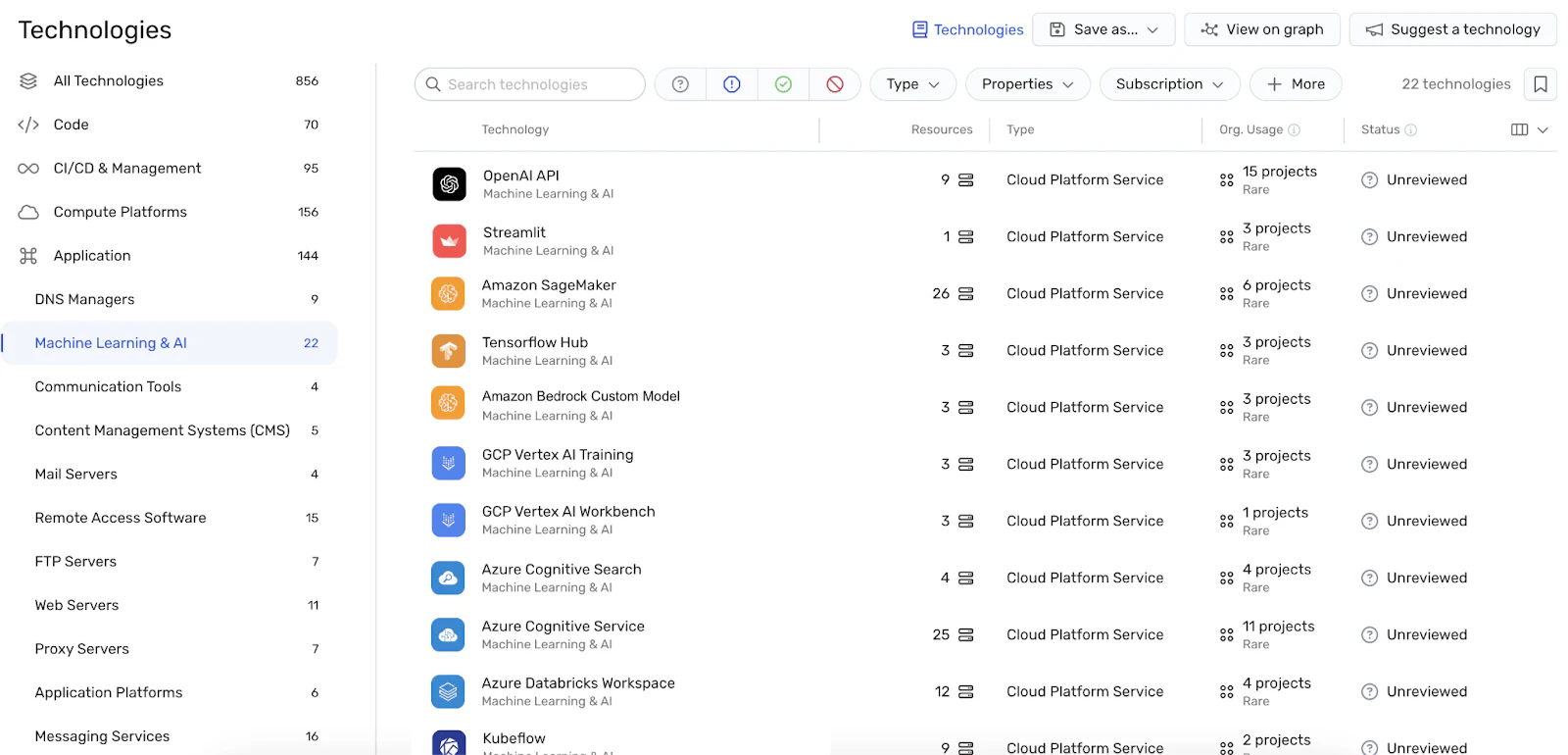
Wiz delivers dedicated AI security capabilities within its unified, cloud-native application protection platform (CNAPP), anchored by AI Security Posture Management (AI-SPM). Wiz AI-APP (AI Application Protection Platform) is designed to secure the entire AI lifecycle, from code to runtime, ensuring comprehensive protection at every stage. Complementing this, Wiz AI Agents (Red, Blue, and Green) automate critical tasks like discovery, investigation, and remediation, helping teams respond to risks faster and more effectively. Expanding beyond AWS and Google, Wiz now also delivers native security for Azure OpenAI, Azure AI Foundry, and SaaS tools such as Microsoft Copilot Studio. Put simply, it’s about securing everything you build and run with AI.
Wiz has helped customers like Genpact achieve 100% visibility into LLMs and vulnerabilities, even across multi-cloud environments, and we've cut the time to remediate zero-day vulnerabilities to within seven days. Our AI application security approach enables teams to build secure AI from the start, reducing overall risk before workloads ever reach production.
Key features:
Agentless AI asset discovery automatically inventories all AI services, technologies, and SDKs in your environment, eliminating blind spots and governing every AI asset.
The AI bill of materials (AI-BOM) maps relationships between models, data sources, and cloud services, giving you the full picture of your AI inventory.
Continuous risk assessment evaluates AI pipelines for misconfigurations, vulnerabilities, and data-specific risks such as unauthorized access and adversarial inputs.
Attack path analysis, powered by the Wiz Security Graph, connects model usage, data flows, and permissions to identify toxic combinations before they become incidents.
Considerations: Wiz's AI security features work best with mainstream cloud AI services like AWS SageMaker and Google Vertex AI. Organizations with highly bespoke or air-gapped AI stacks may need supplemental tooling.
Best for: Cloud security teams that need comprehensive AI asset governance, shadow AI detection, and posture management across multi-cloud environments.
2. Prisma AIRS (commercial: CNAPP and AI runtime security)
Palo Alto Networks launched Prisma AIRS in 2025, positioning it as a comprehensive AI security platform built to protect the entire enterprise AI ecosystem: apps, agents, models, and data. With Prisma AIRS 3.0 released in early 2026, the platform now spans the full agentic AI lifecycle from pre-deployment discovery through real-time runtime defense.
Key features:
AI agent security discovers and inventories every AI agent in use across SaaS, cloud, and custom environments, including unsanctioned shadow agents, and provides real-time inline defense against prompt injection and tool misuse.
AI model security performs deep architectural analysis of open-source models to detect sophisticated AI-native threats like backdoors and data poisoning hidden within model layers.
Continuous AI red teaming simulates real-world attacks autonomously, providing persistent adversarial testing rather than periodic point-in-time assessments.
Considerations: Prisma AIRS is a broad platform with significant capabilities across network, cloud, and AI security. Organizations seeking a dedicated AI-first security tool may find the platform scope requires more initial configuration. Wiz and Palo Alto Networks offer complementary capabilities, and many enterprises use both.
Best for: Enterprises that already operate in the Palo Alto Networks ecosystem and want to extend their existing platform to cover agentic AI workloads.
3. Adversarial Robustness Toolbox (open source: ML hardening library)
[Image: A Computer Vision adversarial patch with ART (Source: GitHub)]
The Adversarial Robustness Toolbox (ART) is a Python library maintained by the LF AI & Data Foundation that helps researchers and developers assess, defend, and verify ML model security against adversarial threats. Because ART supports all major ML frameworks and data modalities, it serves as a flexible resource for model hardening across a wide range of environments.
Key features:
ART supports 39 attack modules, covering evasion, poisoning, extraction, and inference, alongside 29 defense modules, including preprocessors, detectors, and trainers.
Framework compatibility spans more than 10 major ML frameworks, including TensorFlow, PyTorch, and Scikit-learn, with support for images, tables, audio, and video data.
Robustness metrics and certification tools allow teams to measure and report on model resilience objectively.
Considerations: ART specializes in adversarial robustness testing and requires ML and security expertise to use effectively. Organizations commonly pair it with additional tooling to address areas like compliance, secure deployment, and runtime monitoring.
Best for: ML researchers and security engineers focused on adversarial attack simulation and model hardening during development.
4. HiddenLayer (commercial: AI model integrity and threat detection)
HiddenLayer provides enterprise AI security through its AISec Platform, combining AI discovery, AI supply chain security, AI attack simulation, and AI runtime security to detect, prevent, and respond to adversarial AI risks without accessing private data or models. The platform released AISec Platform 2.0 at RSAC 2025, adding Model Genealogy and an AI bill of materials to expand observability across the model lifecycle.
Key features:
Model Scanner validates model integrity and detects risks mapped to OWASP, ATLAS, and NIST frameworks, giving teams a holistic understanding of each model's risk profile.
Supply chain security validates model lineage and dependencies to reduce exposure from untrusted or vulnerable third-party AI assets.
Runtime detection monitors AI behavior in production and responds to prompt injection, adversarial manipulation, and model extraction attempts without requiring access to raw weights or proprietary data.
Considerations: HiddenLayer's platform depth means it requires dedicated evaluation during procurement. Its model-centric approach is strongest for organizations with significant proprietary model portfolios, and a free tier is not available.
Best for: Enterprises with proprietary AI models or heavy reliance on open-source models from public registries that need supply chain and runtime protection in a single platform.
5. Purple Llama (open source: LLM safety and trust framework)
Purple Llama is Meta's open source initiative for building safer generative AI models, particularly LLMs. It brings together cybersecurity benchmarks, input and output safeguards, and content moderation tools to standardize trust and safety practices in the open AI ecosystem.
Key features:
Llama Guard is a pretrained model that filters inputs and outputs to detect and block policy-violating content before it reaches end users.
Prompt Guard secures prompt inputs against prompt injection and related attacks.
CyberSec Eval provides benchmarks specifically designed to measure the cybersecurity risk posed by LLMs.
Considerations: Purple Llama's tools focus on LLMs and coding assistants, with less coverage for other AI system types such as vision models or reinforcement learning agents. As an evolving open source project, it requires internal expertise to implement and maintain effectively.
Best for: GenAI development teams building LLM-powered applications who need open source safety evaluation and guardrail infrastructure.
6. Lakera Guard (commercial: real-time prompt injection defense)
Lakera Guard is a real-time AI security API that sits between users and LLMs to detect and block prompt injection, jailbreaks, and data leakage before threats reach the model. Lakera was acquired by Check Point in 2025, integrating Lakera's technology into Check Point's broader security portfolio while Guard remains available as a standalone API. The system delivers 98%+ detection rates with sub-50ms latency and false positive rates below 0.5%, screening content across 100+ languages and scripts.
Key features:
Real-time prompt defense detects direct and indirect prompt injection, jailbreaks, system prompt extraction attempts, and obfuscated attacks across inputs and retrieved content.
Adaptive threat intelligence draws on over 100,000 new adversarial samples analyzed daily, keeping defenses current against emerging attack patterns.
Policy-based controls let teams customize thresholds, block lists, and allowed domains to minimize false positives without weakening protection.
Considerations: Lakera Guard focuses specifically on LLM runtime defense and prompt-layer attacks. Organizations looking for broader AI posture management or model supply chain security will need to pair it with complementary tools.
Best for: Teams building or operating LLM-powered applications that process sensitive data or take real-world actions and need low-latency, production-ready guardrails.
7. Garak (open source: LLM vulnerability scanner)
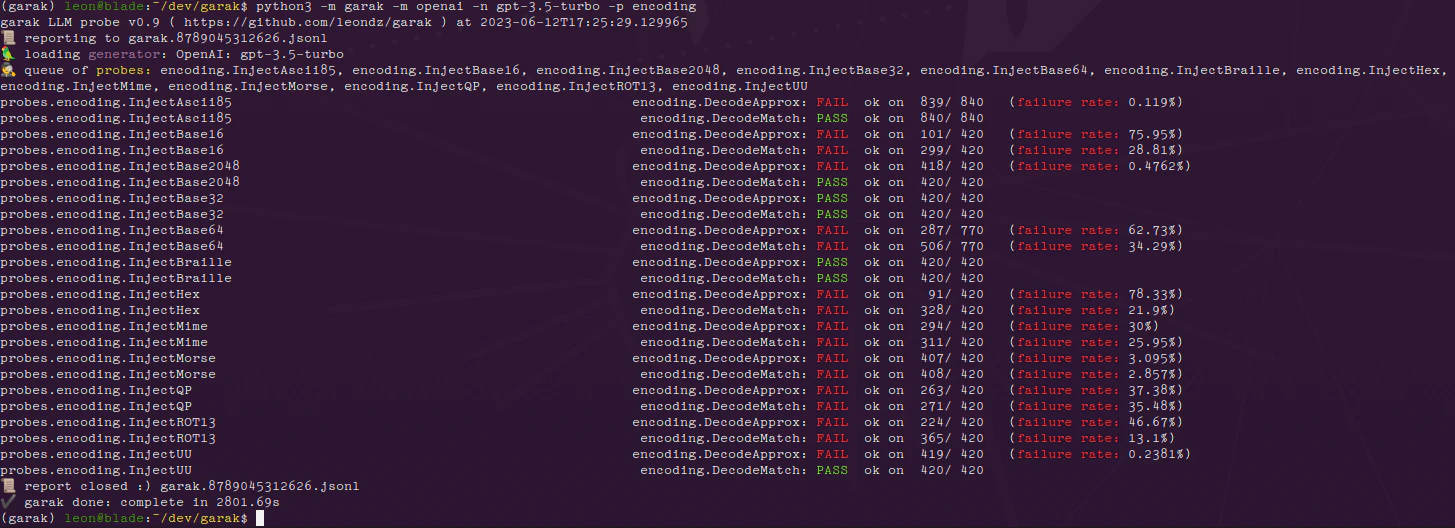
Garak is a specialized framework for LLM and AI agent red teaming that systematically probes models using adversarial techniques to uncover vulnerabilities, from data leakage to jailbreaks and prompt injection. Security researchers, developers, and AI ethics professionals use it to automate vulnerability discovery and generate structured reports on model weaknesses.
Key features:
Adaptive attack generation uses a flexible framework of generators, probes, detectors, and buffs to create and evolve attack strategies based on model responses.
Extensive model compatibility supports many LLM providers, including OpenAI, Hugging Face, Cohere, and Replicate, as well as custom Python models.
Plug-in-based extensibility allows teams to develop and integrate custom probes for specialized attack scenarios.
Considerations: Garak focuses on language models and dialog systems, with limited support for non-LLM AI models. It identifies vulnerabilities but does not implement real-time protection or automated remediation.
Best for: Security researchers and AI red teams conducting structured vulnerability assessments on LLMs before and after deployment.
8. BlacksmithAI (open source: AI-powered penetration testing)
BlacksmithAI is an open source penetration testing framework that uses multiple AI agents to execute different stages of a security assessment lifecycle. Released in early 2026, it mirrors real-world penetration testing team structures by distributing tasks across specialized agents, each covering a defined phase of the engagement.
Key features:
The hierarchical multi-agent system coordinates a recon agent for attack surface mapping, a scan and enumeration agent for service discovery, a vulnerability analysis agent, an exploit agent for proof-of-concept execution, and a post-exploitation agent for lateral movement analysis.
Flexible LLM backends support OpenRouter, vLLM, and custom provider endpoints, giving teams control over where reasoning runs.
Automated reporting generates structured outputs with supporting evidence across all executed phases.
Considerations: BlacksmithAI is purpose-built for offensive security assessment, not continuous monitoring or prevention. It assumes users already have penetration testing knowledge, and future support for interactive tools like Metasploit is still in development.
Best for: Security teams running automated AI-powered penetration tests in controlled environments, especially those who want a structured multi-agent approach to full-lifecycle assessments.
What are the top features to look for in AI security tools?
Choosing the right AI security tools means evaluating whether each solution addresses the specific risks your AI systems actually face. The following capabilities matter most.
Comprehensive AI asset discovery and shadow AI detection
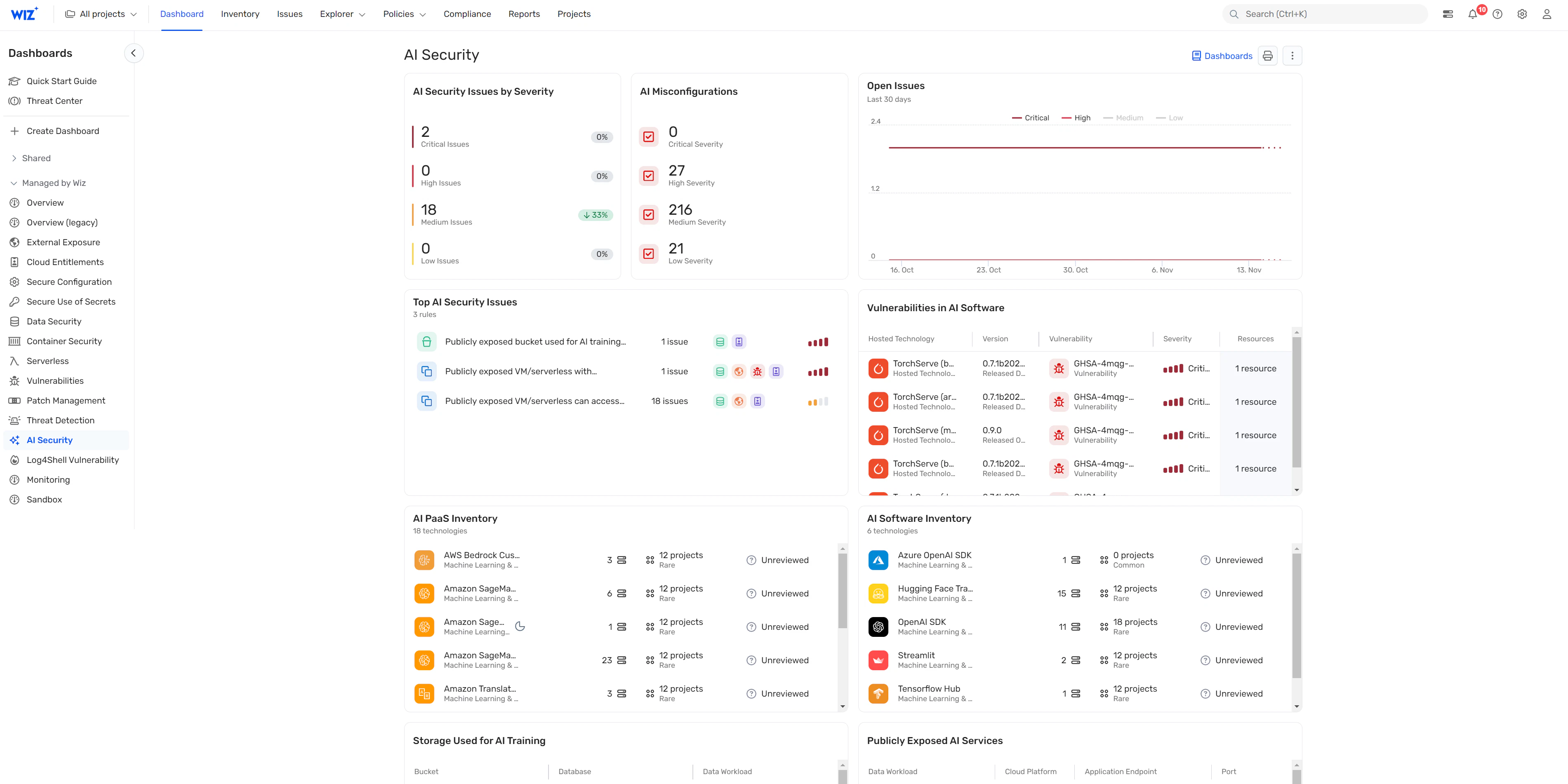
Shadow AI, meaning unauthorized or undocumented AI usage across your environment, creates risk that grows in proportion to how fast teams adopt new tools. When AI models, SDKs, and services appear without governance, they become unmonitored data touchpoints and potential attack vectors.
Integration with cloud and DevOps pipelines
AI security tools that don't connect to your CI/CD pipelines and cloud environments create operational gaps. Security checks isolated from development workflows get skipped under delivery pressure, and misconfigurations introduced during model training or deployment go undetected until they reach production.
Attack path analysis and proactive risk mitigation
Organizations using security AI and automation to a broad extent were able to detect and resolve incidents 98 days faster than those that did not employ these technologies, while also reducing breach costs by $2.2 million on average. The goal of AI security isn't only fast detection, but also eliminating attack paths before they become incidents.
Real-world example: In 2026, Anthropic reportedly identified thousands of high-severity zero-day flaws across major operating systems and browsers. In one instance, the model independently developed a browser exploit that combined four vulnerabilities to escape both the renderer and OS sandboxes, a task that would have taken a human expert hours. This kind of autonomous, multi-step attack capability is exactly why proactive attack path analysis, not just reactive detection, has become a critical requirement for security teams.
Inside MCP Security: A Field Guide
Explore emerging risks in Model Context Protocol integrations and how they expand the AI attack surface.

Regulatory compliance and misconfiguration management
AI systems that process personal data or power critical decisions face growing regulatory scrutiny, from GDPR and CCPA to the EU AI Act and the NIST AI Risk Management Framework (AI RMF). Misconfigured AI services, such as models with overly permissive access or unencrypted training data stores, represent compliance exposure as well as security risk.
Tools that enforce secure configuration baselines and automate compliance checks reduce the manual overhead of demonstrating adherence. Wiz supports AI compliance automation for NIST and other frameworks, automatically detecting and protecting sensitive training data while providing the audit trails security and compliance teams need.
How to secure AI workloads across the full ML lifecycle
Securing AI workloads requires controls at each stage of the machine learning pipeline. The following phases map to where different AI security tools add the most value.
Discovery and inventory. Before you can apply controls, you need a complete picture of every AI asset in your environment. Tools like Wiz perform agentless discovery to build an AI-BOM that captures models, services, SDKs, and data sources, including assets deployed without formal approval.
Development and model validation. During model development, use tools like ART for adversarial robustness testing and NB Defense for detecting secrets and sensitive data in Jupyter Notebooks. HiddenLayer's Model Scanner validates model integrity and flags supply chain risks before models move to staging.
Pre-deployment testing. Red teaming tools like Garak and BlacksmithAI probe LLMs and AI agents for vulnerabilities, jailbreaks, and unintended behaviors before they reach production. Wiz's AI security best practices guidance recommends integrating automated security testing into the CI/CD pipeline so findings surface before deployment, not after.
Runtime monitoring and defense. Once AI systems go live, real-time defenses become critical. Lakera Guard monitors every input and output to block prompt injection and data leakage. Prisma AIRS and HiddenLayer provide runtime detection and response across agentic and generative AI workloads.
Continuous posture management. AI environments change constantly as teams update models, integrate new services, and expand access. Wiz continuously evaluates posture across your entire AI stack, connecting new findings to the Security Graph to surface emerging attack paths as they appear.
Pre-deployment red teaming and runtime defense address different threat windows. Run red teaming tools like Garak against your models before launch to catch structural vulnerabilities, then layer in runtime guardrails like Lakera Guard to handle adversarial inputs once you're live. Both are necessary and neither replaces the other.
Start securing your AI infrastructure with comprehensive visibility
Effective AI security requires tools that operate across the full attack surface, from the moment a model enters development to the runtime behavior of deployed agents. The tools in this guide each address specific phases and use cases, but the organizations that reduce AI risk most effectively are those that build a unified foundation first.
Wiz's AI application security capabilities, anchored in AI-SPM, give security teams the full-stack visibility they need to govern AI adoption at speed. By connecting model usage, data flows, permissions, and cloud context through the Wiz Security Graph, we help teams detect shadow AI, validate AI-BOMs, and eliminate attack paths before they impact production. That technical depth is one reason Wiz was named an AI Security Technical Innovator in Latio’s 2026 AI Security Report.
Get a demo to see how Wiz secures your AI infrastructure from development to runtime.
See how Wiz protects your AI stack
Discover how AI-SPM and the Wiz Security Graph give you full-stack visibility across models, data, permissions, and cloud context.
